
Show me the money – early sowing into low seedbank
Below is the output from a RIM run we developed here at AHRI to demonstrate how the Ryegrass Integrated Management (RIM) computer model can be used to put theories to the test.
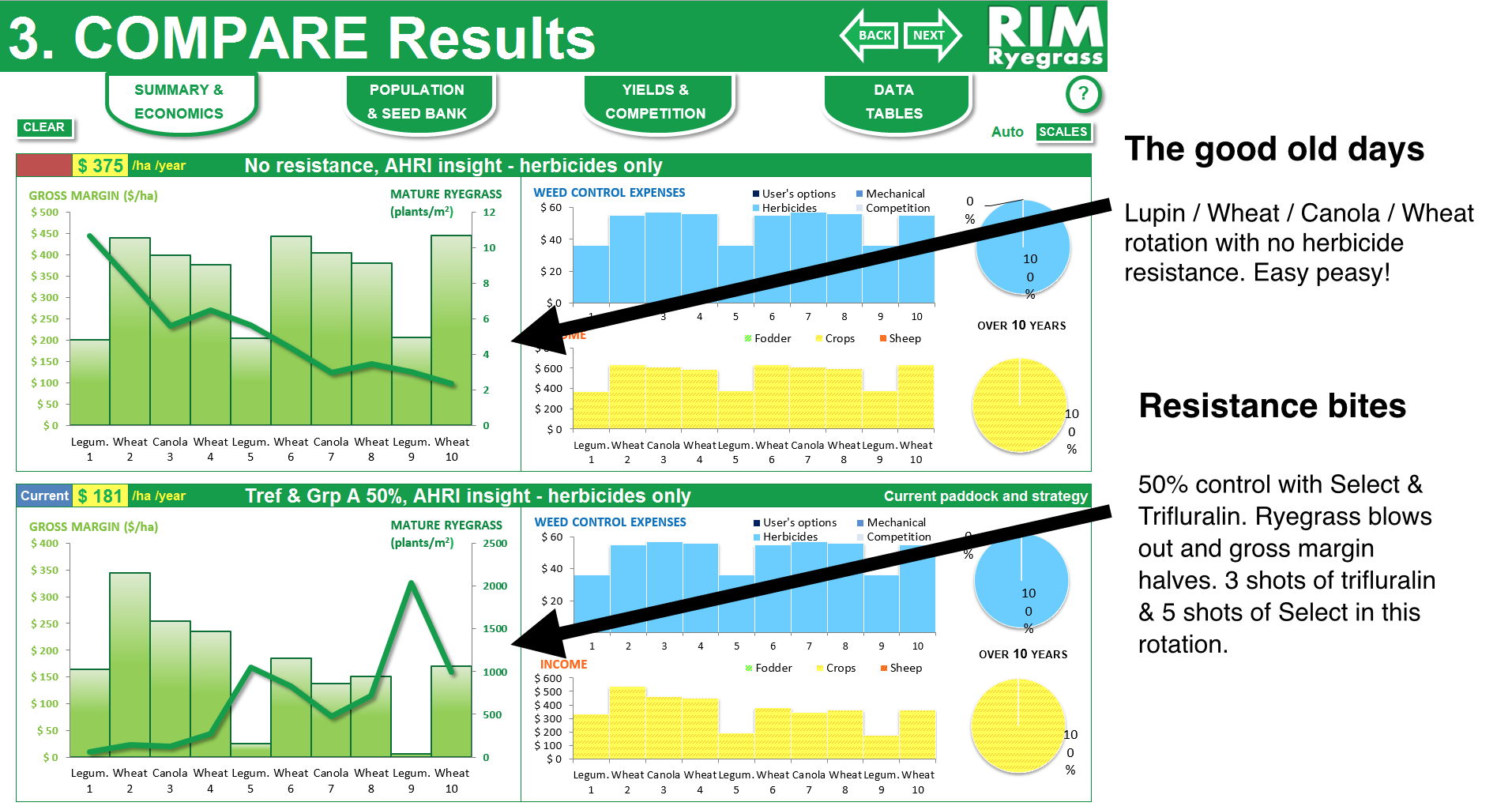
Have you ever wondered what it would be like if trifluralin and clethodim (Select®) stopped working? We used RIM to simulate this scenario and then made some changes to weed management to see if we could get back to growing continuous, clean, profitable crops.
Top: herbicide dominant, no resistance. Bottom: same herbicide dominant rotation with 50% Select and trifluralin resistance.
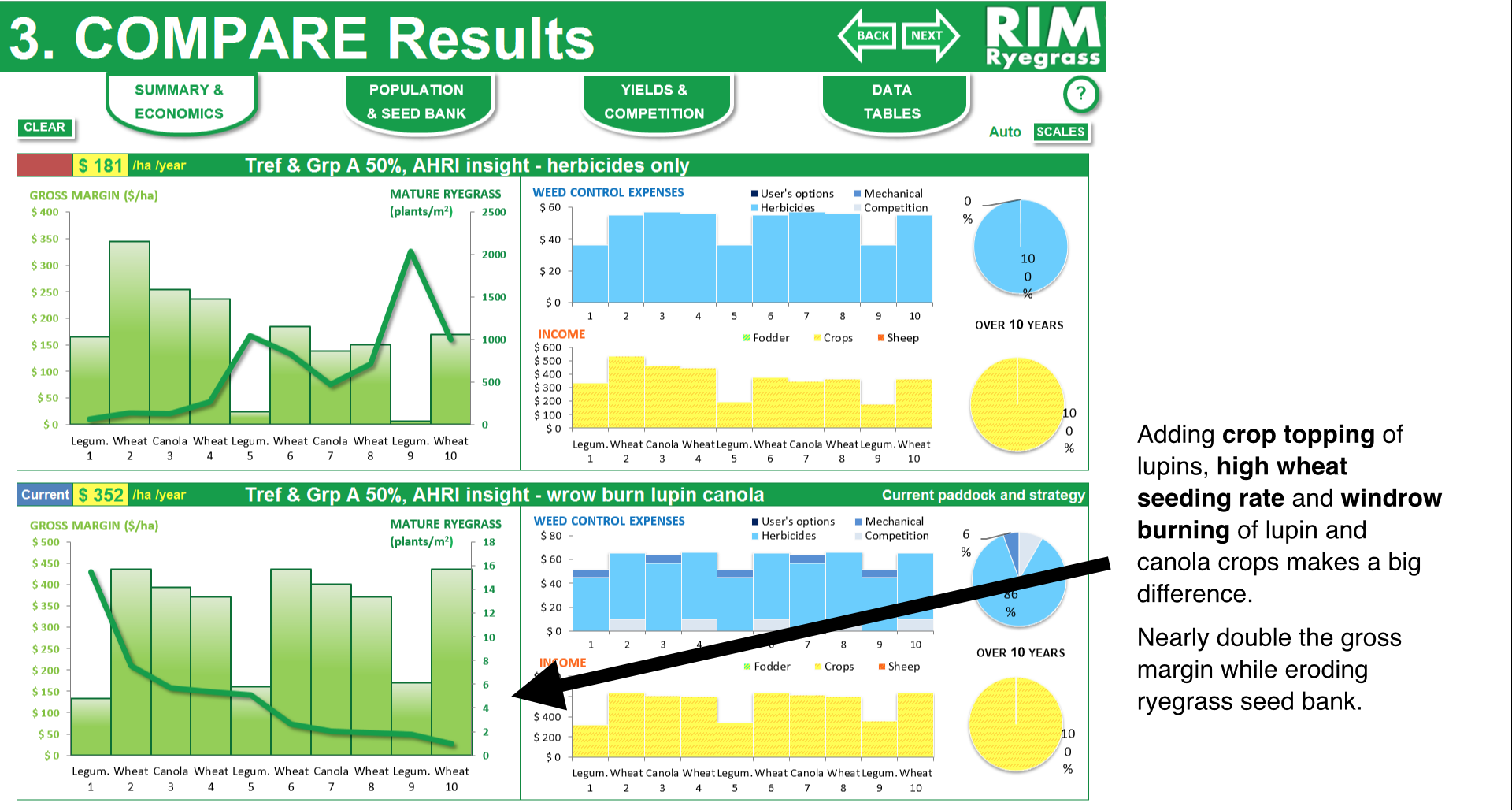
Can we fix this problem by adding more weed control tools?
Top: herbicide dominant with resistance. Bottom: same resistance plus extra weed management.
What happens if we now move to a chaff cart every year instead of windrow burning lupin and canola? We can improve our profitability by moving to earlier sowing.
Top: chaff cart every year plus high wheat seeding rate. Bottom: as for top graph but with earlier sowing.
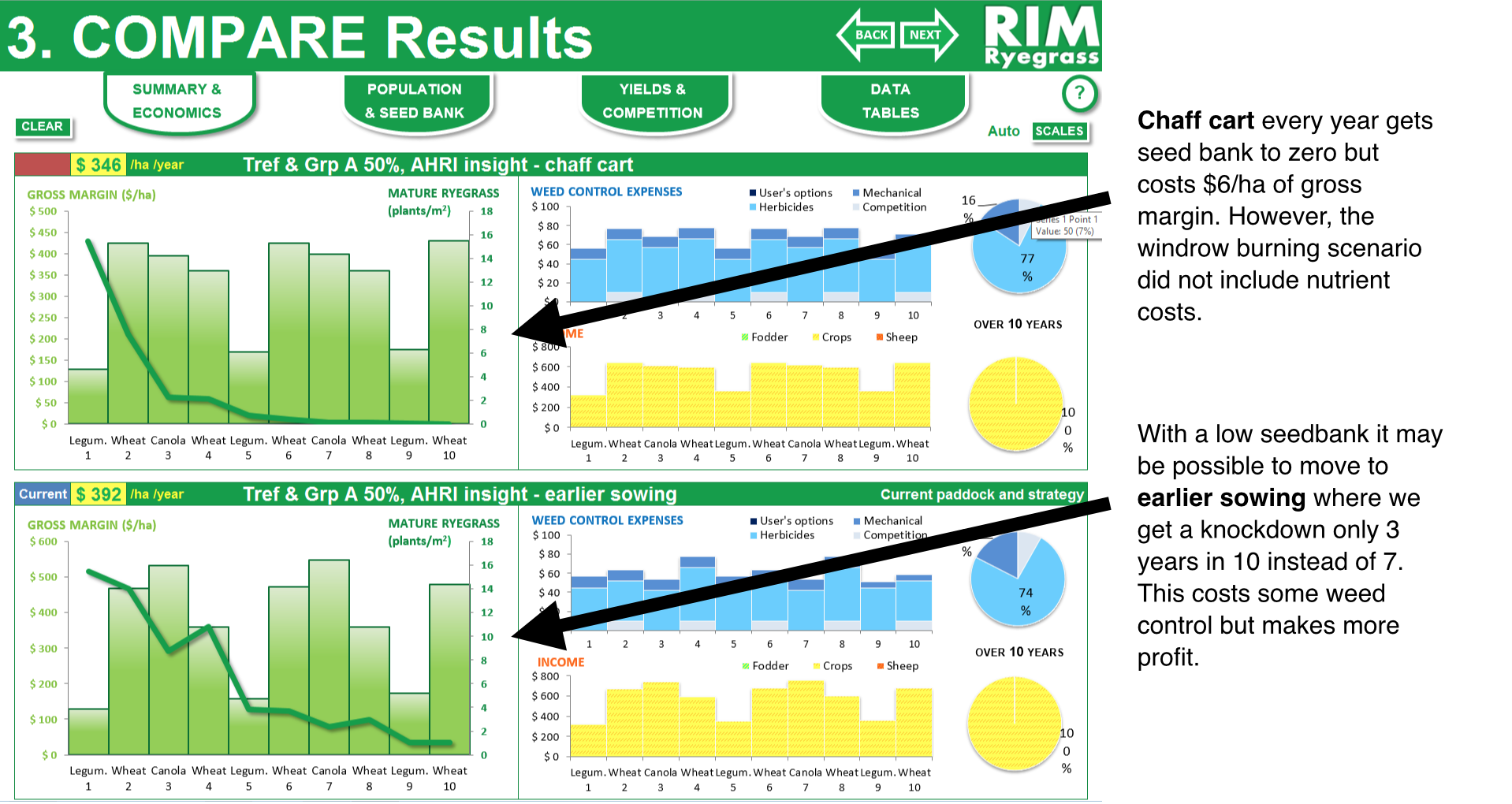
This scenario shows that as herbicide resistance bites the costs to gross margin and the ryegrass seedbank can be devastating if we continue to rely on herbicides. However, adding extra weed management gets on top of the seed bank, and it may be possible to move seeding forward to benefit from early sowing and increase profit if the seed bank is under control.
RIM is a great tool to compare some weed control strategies using computer simulation before making the changes on farm. RIM simulates the ryegrass seedbank based on years of research data to give realistic results.
Download RIM for free and give it a try.

Assumptions
Some of the assumptions used in this simulation are:
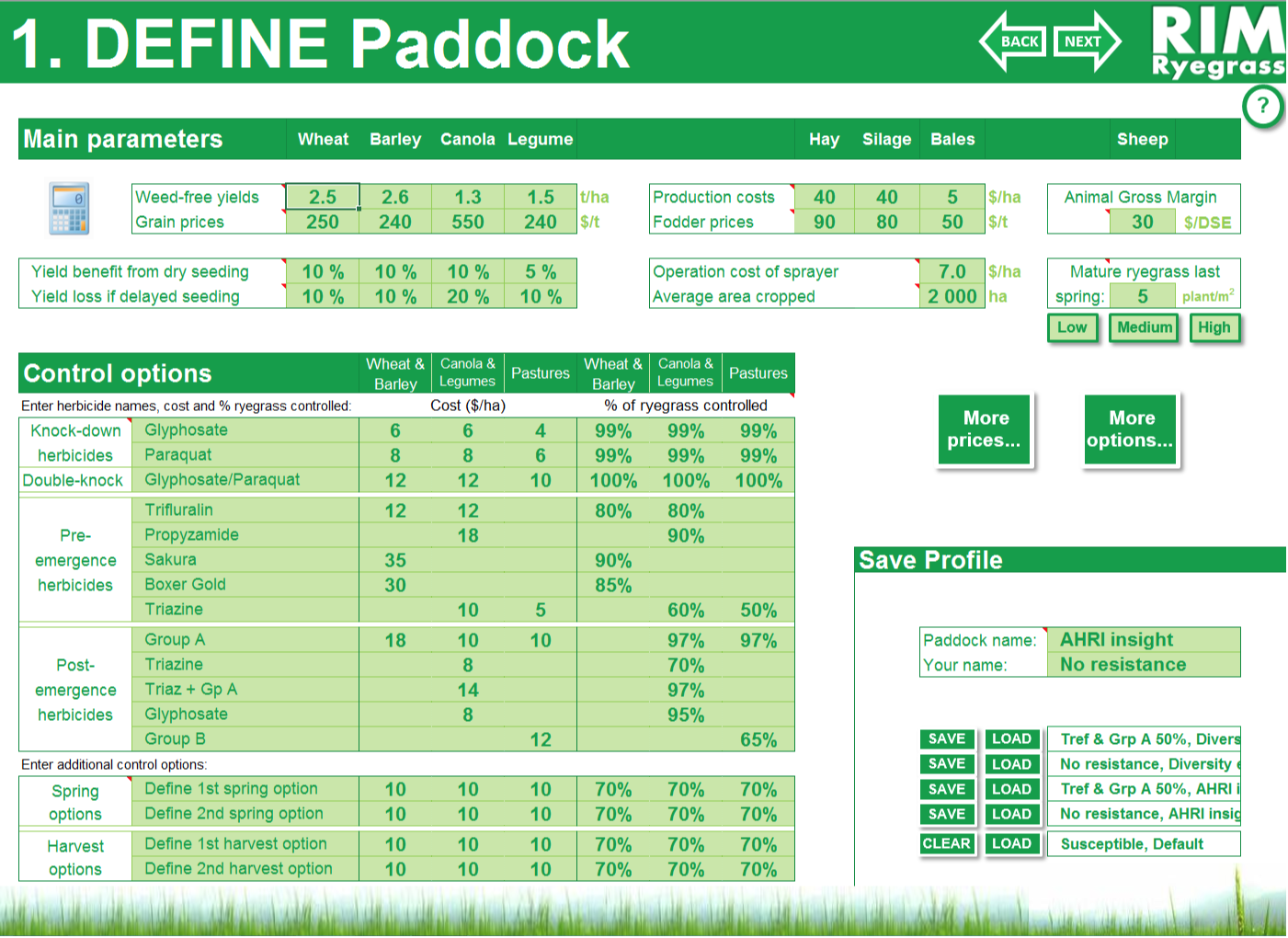
- Yields. Wheat 2.5 t/ha; Barley 2.6 t/ha; Canola (TT) 1.3 t/ha; Lupin 1.5 t/ha.
- Herbicide control %. Trifluralin 80%; Propyzamide 90%; Sakura 90%; Boxer Gold 90%. Clethodim (Group A) 97%.
- Chaff cart / Windrow burn – removed 70% of ryegrass seed in crop.
- Crop topping lupin – 75% reduction in ryegrass seed set.
The picture below shows some of the assumptions used for these scenarios. All of these assumptions can be adjusted to suit a particular farm.